<1>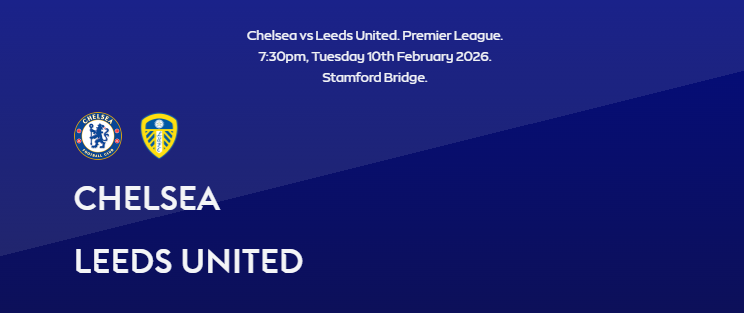
<10>Chelsea vs Leeds United
Chelsea’s recent form is clearly trending upward. From a results standpoint, they have recorded five wins and one loss across their last six matches in all competitions, showing strong overall stability. More importantly, this run is not driven by isolated moments of luck, but by a visible improvement in game control and squad availability.

In league play, Chelsea have gradually worked their way back toward the European qualification picture after 25 rounds. Their objective in the second half of the season is clear: turn home fixtures into consistent points and convert pressure into a positional advantage. Stamford Bridge has been a major stronghold — across their last ten home matches, Chelsea have gone on to win 80% of the games in which they scored first, highlighting how effectively they manage matches once ahead.
From a tempo perspective, Chelsea are not a slow-starting side. Seven of their last ten competitive matches have seen goals before halftime, underlining their willingness to impose attacking pressure early rather than easing into games.
Defensively, Chelsea remain one of the most reliable units in the league. After 24 league matches, they have conceded just 28 goals, the third-lowest total in the Premier League, averaging roughly 1.08 goals conceded per game. Operating within a 4-2-3-1 structure, their defensive strength is not about crowding the back line, but rather midfield shielding and rapid collective recovery. At home in particular, Chelsea excel at winning the ball back higher up the pitch, significantly reducing direct pressure on their defenders.
That said, discipline remains a concern. Chelsea have accumulated five red cards across 25 league matches, the highest tally in the league. This introduces an element of risk — in high-intensity contests, a lapse in emotional or defensive control can disrupt their overall structure. Offensively, however, Chelsea do not rely on a single focal point. Their attacking approach is built around multi-point link-up play across the midfield and forward lines, and the frequent early goals further confirm their strong efficiency in the opening phases of matches.

Leeds United’s recent form has been volatile and tense. While results have not completely collapsed, their match-to-match consistency is clearly lacking. Data shows that seven of Leeds’ last ten competitive games have also featured first-half goals, indicating a high-tempo approach that exposes risk early. This can be effective against lower-tier opponents, but away at Stamford Bridge — against a deeper and more complete Chelsea side — their margin for error is significantly reduced.
Historical trends are not in Leeds’ favor either. They have lost every away match against Chelsea over the past five years, placing them at a clear psychological disadvantage.
Leeds’ performance profile is more extreme at both ends of the pitch. They possess attacking threat, but lack consistency. Defensively, they rely more on shape and compactness rather than individual recovery ability. Once that structure is disrupted, defensive recovery is slow. This is reflected in the numbers: when falling behind, Leeds go on to lose around 70% of matches, highlighting their limited in-game adjustment capacity. Conversely, when scoring first, their win rate jumps to 80%, which explains their aggressive early tempo — they understand that taking the lead fundamentally shifts the match in their favor.
From a market perspective, European odds have shortened on the home win, while draw and away prices have drifted. The Asian line currently sits at Chelsea -1, which aligns with historical head-to-head pricing. Notably, the market has not overreacted to Chelsea’s winning streak, suggesting a protective adjustment rather than inflation.
Based on the full analysis, our prediction is: Home win.

Tottenham vs Newcastle United
This is a high-risk investment fixture. While I personally lean toward Tottenham to win or draw, we do not recommend taking a position on those outcomes. From a risk-management standpoint, our team believes the more stable angle is:
Both Teams to Score (BTTS).



Post Comment Cancel Reply