<1> Manchester United vs Aston Villa
<10>
As the 2025/26 Premier League season enters its decisive final third, the clash between Manchester United and Aston Villa on March 15, 2026 at Old Trafford is widely viewed as a potential turning point in the race for Champions League qualification.
Historical Head-to-Head
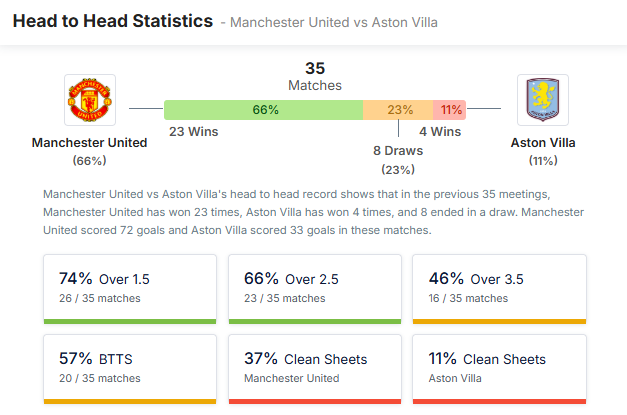
Historically, Manchester United have held a clear psychological and statistical edge over Villa.
Across the last 35 meetings in all competitions, United have recorded 23 wins, 8 draws, and only 4 defeats, giving them a 66% win rate. That dominance is even more pronounced at Old Trafford.
Since 1983, United have lost just two of their last 37 home league games against Aston Villa.
The data also shows that this fixture tends to produce goals:
74% of matches have produced over 1.5 goals
66% have gone over 2.5 goals
Manchester United have scored 72 goals in those meetings (more than 2 per game on average), while Villa have managed just 33.
Another notable statistic: United have kept clean sheets in 37% of those games, compared to only 11% for Villa. Historically, United’s attacking efficiency at home has been the defining factor in this matchup.
Current Table Situation
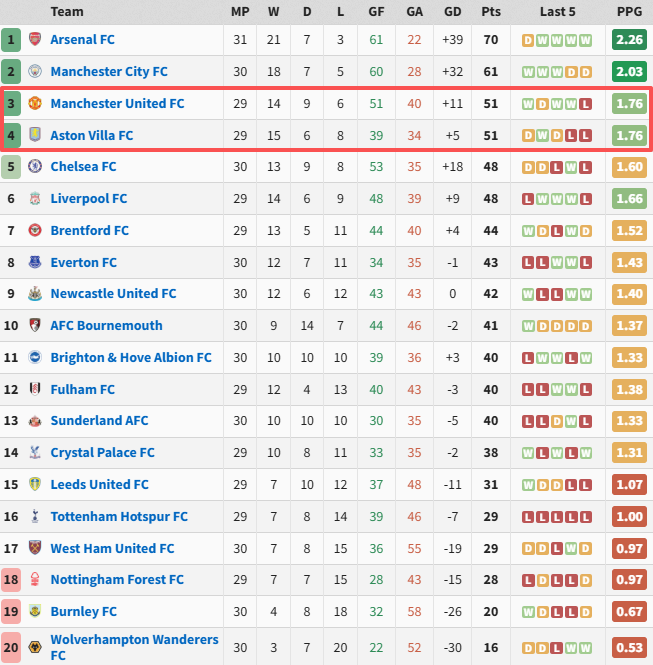
By mid-March, the Premier League table has become extremely tight.
Manchester United: 3rd place, 51 points from 29 matches
Aston Villa: 4th place, also 51 points from 29 matches
The only difference is goal difference:
United +11
Villa +5
United also hold a significant advantage in attacking output, having scored 51 goals compared to Villa’s 39.
Since Michael Carrick took charge, United’s frontline — featuring Bryan Mbeumo, Benjamin Šeško and Matheus Cunha — has shown impressive attacking firepower and tactical flexibility.
Mbeumo leads the team with 9 league goals, and his ability to cut inside from the right and deliver dangerous set pieces has been key to unlocking defenses.
Šeško is currently in outstanding form, scoring in three consecutive Premier League matches against Crystal Palace, Everton, and West Ham United, bringing his season tally to 8 goals.
Tactical Improvement Under Carrick
After Carrick replaced Rúben Amorim, Manchester United went on a run of six wins and one draw, once again highlighting how important the club’s tactical identity is.
In reality, United’s squad quality has always been strong by Premier League standards. The club also invested heavily this season, meaning the individual quality of the players was never the issue — the key problem was always the attacking structure.
During Amorim’s tenure, several players struggled to fully express their abilities. But under Carrick, once the team’s true creative core — Bruno Fernandes — was given the freedom to orchestrate play, the entire attacking system began to function much more effectively.

Fernandes’ ability to link play and distribute the ball into dangerous areas remains irreplaceable. His vision and passing rhythm are what consistently move United’s attacks into genuinely threatening positions.
United’s unbeaten run finally ended last round when they suffered a late defeat to Newcastle United, but overall the improvement under Carrick remains clear.
Aston Villa’s Mid-Season Decline
Villa’s drop in form during the second half of the season has been largely driven by injuries to three key midfielders:
John McGinn
Boubacar Kamara
Youri Tielemans
These absences significantly weakened Villa’s midfield control and defensive balance.
Although captain McGinn has returned to training and could start against Manchester United, the lack of rotation means his midfield engine may struggle to operate at full efficiency.
Realistically, Villa’s current league position also reflects their true competitive level. Their primary objective now is to collect as many points as possible in the remaining fixtures to secure European qualification for next season.
Manchester United will still be missing winger Amad Diallo, but Matheus Cunha is capable of covering that role.
The bigger concern for Carrick lies in defense:
Noussair Mazraoui was injured in the match against Newcastle.
Matthijs de Ligt and Lisandro Martínez remain sidelined.
That means United will likely continue relying on the partnership of Harry Maguire and young defender Leny Yoro.
Key Factor: Physical Condition
One of the most decisive elements in this matchup is fitness.
Villa played a Europa League away match against Lille OSC just two days ago, while Manchester United have enjoyed a full 10 days of rest.
Historical Premier League data shows that when a team has more than seven days of rest while their opponent has less than three days (especially after international travel), the well-rested team’s probability of scoring between the 60th and 90th minute increases by around 22%.
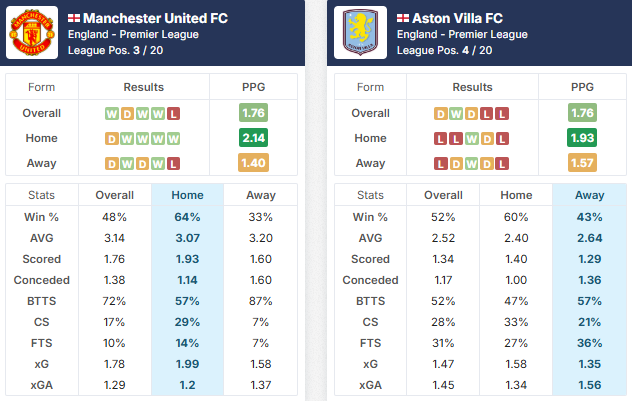
Given that Manchester United have now scored in 17 consecutive league matches, and Aston Villa concede 1.36 goals per away game, it’s reasonable to expect United to use their fitness advantage and high pressing in the final 30 minutes to create scoring opportunities.
From a market perspective:
European odds have lowered the price for a home win
Draw and away win odds have increased
Meanwhile, the Asian handicap remains at Manchester United -0.75, with a slight reduction in the payout on the home side.
Compared with the handicap lines from the two meetings between these teams in 2025, the -0.75 line is slightly stronger, suggesting that bookmakers and the market have growing confidence in a United victory.
Recommended bet: Home Win (Manchester United)
Crystal Palace vs Leeds United
Prediction: 2X (Draw or Leeds United Win)




Post Comment Cancel Reply